Magical Miniature Gardens & Homes: Create Tiny Worlds of Fairy Magic & Delight with Natural, Handmade Décor
Donni Webber
4/5 stars
Magical Miniature Gardens & Homes is filled with charming ideas for making a fairy garden or home. The photos are gorgeous; it's worth owning the book just to browse through the environments and decor.
The instructions for creating the pieces of the fairy land are detailed, and accompanied by illustrations. However, despite the title saying "natural decor", many of the them are made from materials that one doesn't usually have on hand, such as polymer clay or copper wire. More than a few were also of fairly complicated design: twisting wire, weaving a basket, making bricks. Crafting tools are used that require an adult, and that are also not available in every home. It certainly is not a book that a child could follow to create a fairy home, and the less crafty of adults will also find it difficult.
While it may not be able to be an instruction guide for every reader, it will spark the imagination and possibly lead to other designs made from things on hand. Also, as I said above, it is a pleasure simply to peruse the photos.

Showing posts with label Gypsi's reviews. Show all posts
Showing posts with label Gypsi's reviews. Show all posts
Tuesday, January 31, 2017

Monday, January 30, 2017
Song of Achilles by Madeline Miller
Song of Achilles
Madeline Miller
4/5 stars
Song of Achilles is a retelling of Achilles' part in the Trojan war, narrated by friend and lover Patroclus. I was not particularly impressed with Miller's interpretation of the child Achilles, and I felt that her romance-telling skill was weak. However, once Troy was reached, Miller's writing improved and she told the story excellently, with especially good use of metaphor and simile.
Madeline Miller
4/5 stars
Song of Achilles is a retelling of Achilles' part in the Trojan war, narrated by friend and lover Patroclus. I was not particularly impressed with Miller's interpretation of the child Achilles, and I felt that her romance-telling skill was weak. However, once Troy was reached, Miller's writing improved and she told the story excellently, with especially good use of metaphor and simile.
Sunday, January 29, 2017
Seventy-Seven Clocks by Christopher Fowler
Seventy-Seven Clocks
Christopher Fowler
4/5 stars
Detectives Bryant and May run London's Peculiar Crimes Unit, where the most unusual cases get investigated. In this third book of the series, a spate of bizarre murders comes to their attention. In investigating these connected deaths, they find themselves researching a Victorian tontine, protecting the most crabby of families, and receiving unsolicited help from a nosy teenager.
As with the other two PCU books, the plot of Seventy-Seven Clocks is bizarre and convoluted, but in a good way, keeping the reader guessing. Bryant and May are engaging characters, giving much personality to the novel. The interwoven plot of the teenager, Sam, added an extra dimension. This is a fun novel for readers that appreciate a far-fetched but enjoyable mystery.
Christopher Fowler
4/5 stars
Detectives Bryant and May run London's Peculiar Crimes Unit, where the most unusual cases get investigated. In this third book of the series, a spate of bizarre murders comes to their attention. In investigating these connected deaths, they find themselves researching a Victorian tontine, protecting the most crabby of families, and receiving unsolicited help from a nosy teenager.
As with the other two PCU books, the plot of Seventy-Seven Clocks is bizarre and convoluted, but in a good way, keeping the reader guessing. Bryant and May are engaging characters, giving much personality to the novel. The interwoven plot of the teenager, Sam, added an extra dimension. This is a fun novel for readers that appreciate a far-fetched but enjoyable mystery.
Friday, January 27, 2017
Circles : Fifty Roundtrips Through History, Technology, Science, Culture... by James Burke
Circles : Fifty Roundtrips Through History, Technology, Science, Culture...
James Burke
5/5 stars
 Circles is a sort of "six degrees of separation" in which Burke begins with an idea or person (history, technology, science, culture, the like) and through connections with other ideas or people, circles back around to the beginning point.
This is a witty, interesting, and informative book that reads like having a conversation with the author. Most lead me to want to research further on my own. Some of the links are more tenuous than others, but that doesn't lessen the entertainment value of the essay.
The important thing to remember about Circles is that it is not intended to be read straight through. One or two essays at time, at most, should be read, digested, enjoyed before proceeding to another. Trying to read multiple chapters at a time will result in an overdose of Burke's humor, and an inability to remember any of the details.
I highly recommend Burke in general, and Circles in particular for the lay-historian.
(And yes, I have, and have had since the early 1990's, a painful schoolgirl-crush on Burke.)
James Burke
5/5 stars
Circles is a sort of "six degrees of separation" in which Burke begins with an idea or person (history, technology, science, culture, the like) and through connections with other ideas or people, circles back around to the beginning point. This is a witty, interesting, and informative book that reads like having a conversation with the author. Most lead me to want to research further on my own. Some of the links are more tenuous than others, but that doesn't lessen the entertainment value of the essay.
The important thing to remember about Circles is that it is not intended to be read straight through. One or two essays at time, at most, should be read, digested, enjoyed before proceeding to another. Trying to read multiple chapters at a time will result in an overdose of Burke's humor, and an inability to remember any of the details.
I highly recommend Burke in general, and Circles in particular for the lay-historian.
(And yes, I have, and have had since the early 1990's, a painful schoolgirl-crush on Burke.)
Sunday, January 22, 2017
Goodbye Days by Jeff Zentner
Goodbye Days
Jeff Zentner
expected publication date: March 7, 2017
4/5 stars
Carver's three best friends, Mars, Eli, and Blane, die in a car crash. In the wreckage, Mars' phone is found replying to a text from Carver, and Carver can't stop blaming himself. Neither can Mars' Judge father, whose influence opens a criminal investigation against Carver. Carver finds himself ostracized at his high school and suffering from panic attacks. His only allies outside of family are Eli's girlfriend who needs support herself, and Blane's grandmother who requests that Carver have a "goodbye day" with her.
This "goodbye day" would be a day where she and Carver do all the favorite things that she did with Blane, to find closure. Unexpectedly, Eli's parents, and later Mars' father, ask for a goodbye day, as well, but their motives might be different.
Carver faces deep emotional turmoil as he examines his role in the accident, and tries to come to grips with his grief.
Goodbye Days is written for a Young Adult audience, with the intention of providing a realistic example of dealing with grief. Zentner does this well. He also does an excellent job portraying the depth of grief, panic attacks, and the different reactions that grief can cause. His writing is strong, his characters lifelike, and the plot believable.
That being said, I must confess that I had no connection with any of the characters in the story. I didn't find Carver's memories of his friends funny or touching, nor did I become emotionally invested in his grief. Furthermore, I found the descriptions of the goodbye days to be off-putting and slightly creepy.
I have read other reviews of this book on Goodreads, and I know that my reaction is the atypical one, so I'll stress that this review, as is any review, is simply my personal opinion.
Jeff Zentner
expected publication date: March 7, 2017
4/5 stars
Carver's three best friends, Mars, Eli, and Blane, die in a car crash. In the wreckage, Mars' phone is found replying to a text from Carver, and Carver can't stop blaming himself. Neither can Mars' Judge father, whose influence opens a criminal investigation against Carver. Carver finds himself ostracized at his high school and suffering from panic attacks. His only allies outside of family are Eli's girlfriend who needs support herself, and Blane's grandmother who requests that Carver have a "goodbye day" with her.
This "goodbye day" would be a day where she and Carver do all the favorite things that she did with Blane, to find closure. Unexpectedly, Eli's parents, and later Mars' father, ask for a goodbye day, as well, but their motives might be different.
Carver faces deep emotional turmoil as he examines his role in the accident, and tries to come to grips with his grief.
Goodbye Days is written for a Young Adult audience, with the intention of providing a realistic example of dealing with grief. Zentner does this well. He also does an excellent job portraying the depth of grief, panic attacks, and the different reactions that grief can cause. His writing is strong, his characters lifelike, and the plot believable.
That being said, I must confess that I had no connection with any of the characters in the story. I didn't find Carver's memories of his friends funny or touching, nor did I become emotionally invested in his grief. Furthermore, I found the descriptions of the goodbye days to be off-putting and slightly creepy.
I have read other reviews of this book on Goodreads, and I know that my reaction is the atypical one, so I'll stress that this review, as is any review, is simply my personal opinion.
Saturday, January 21, 2017
The Girl From His Town by Marie Van Vorst
The Girl From His Town
Marie Van Vorst
3/5 stars
In this light Edwardian novel (published 1910), a young American millionaire, Dan Blair, falls prey to a fortune-hunting Duchess, then falls in love with an actress from his town.
There is nothing unusual about this romance; it follows an established formula, and is quickly forgotten. The period detail and atmosphere is charming, however, and will make it enjoyable to fans of the Edwardian era.
It is available for free from Project Gutenberg.

Marie Van Vorst
3/5 stars
In this light Edwardian novel (published 1910), a young American millionaire, Dan Blair, falls prey to a fortune-hunting Duchess, then falls in love with an actress from his town.
There is nothing unusual about this romance; it follows an established formula, and is quickly forgotten. The period detail and atmosphere is charming, however, and will make it enjoyable to fans of the Edwardian era.
It is available for free from Project Gutenberg.

Monday, January 16, 2017
She and Allan by H. Rider Haggard
She and Allan
H. Rider Haggard
3/5 stars
 Published in 1921, She and Allan brings together Haggard's two most popular characters: Allan Quatermain and Ayesha. Allan seeks out Ayesha, through the encouragement of the witch doctor Zikali, in hopes of finding answers about dead loved ones. He becomes involved in the rescue attempt of a young Portuguese-Scotch woman, as well as a battle between Ayesha's followers and her enemies.
I thoroughly enjoyed She, which introduces Ayesha, and am a long-standing fan of the Quatermain books. I found this one to be sub-par for Haggard, as there is frequent pseudo-philosophical screed that was often mind-numbingly dull for me. I did like, though, how different Ayesha's relationship was with Allan as compared to that with Leo and Holly. I also liked that she told Allan a just-sightly different version of her history that than which was told in both She and Ayesha.
Allan's skepticism, though, kept the preternatural abilities of Ayesha from being fully enjoyed, leaving the reader to figure out the truth in between her speeches and his thoughts.
The action was, as is usual with Haggard, excellent and exciting. Allan Quartermain is a hero I particularly enjoy reading about, and I think Haggard has done a wonderful job of developing his character. I also liked getting to know Umslopogaas and wish that I had read his story in Nada the Lilly prior to this, and look forward to reading it later.
Sadly, I can't rate She and Allan any higher than 3 stars, due to the long, dull speeches and explanations of Ayesha. If one is willing to skim over those bits, though, and focus on the rest of the plot, this is a good yarn.
H. Rider Haggard
3/5 stars
I thoroughly enjoyed She, which introduces Ayesha, and am a long-standing fan of the Quatermain books. I found this one to be sub-par for Haggard, as there is frequent pseudo-philosophical screed that was often mind-numbingly dull for me. I did like, though, how different Ayesha's relationship was with Allan as compared to that with Leo and Holly. I also liked that she told Allan a just-sightly different version of her history that than which was told in both She and Ayesha.
Allan's skepticism, though, kept the preternatural abilities of Ayesha from being fully enjoyed, leaving the reader to figure out the truth in between her speeches and his thoughts.
The action was, as is usual with Haggard, excellent and exciting. Allan Quartermain is a hero I particularly enjoy reading about, and I think Haggard has done a wonderful job of developing his character. I also liked getting to know Umslopogaas and wish that I had read his story in Nada the Lilly prior to this, and look forward to reading it later.
Sadly, I can't rate She and Allan any higher than 3 stars, due to the long, dull speeches and explanations of Ayesha. If one is willing to skim over those bits, though, and focus on the rest of the plot, this is a good yarn.
Saturday, January 14, 2017
The Fifth Wheel by Olive Higgins Prouty
 |
original illustration by James Montgomery Flagg |
Olive Higgins Prouty
3/5 stars
The Fifth Wheel (published 1915) picks up where Bobbie, General Manager (my review here) ends, but with Ruth as the main character, instead of her sister Bobbie. Ruth has been trained to be a mindless debutante, but decides to try a different path and find a job in New York City.
While Ruth's story was mostly enjoyable, I found some of her adventures--and her happy ending--to be improbable. In addition, I was disconcerted by the details of events not matching between the two novels. I also grew tired of the discussions about suffrage and woman's-place, feeling that Prouty used this novel more as a platform to air opinions than to tell a story.
Despite my complaints, it was, as I said, mostly enjoyable; a quick, light read that gives an idea of what life was like during the American Gilded Age.
A Christmas Beginning by Anne Perry
A Christmas Beginning
Anne Perry
3/5 stars
A Christmas Beginning is one of Perry's annual Christmas stories that feature less major characters from her two established series. In this one, Inspector Runcorn (from the William Monk series) is on holiday when he discovers a gruesome murder.
As is the case with many Perry novels, this one is very introspective, focusing more on what Runcorn is thinking and deducing, than on action or conversation. The mystery itself was interesting, though not difficult to solve.
Having followed the two characters involved in this book's romance from the beginning in the Monk series, I felt that the happy conclusion was both sudden and improbable.
One thing that continued to bother me throughout the novel was the familiar use of first names by Runcorn and others not in the circle of intimate friends. This did not fit with what I know of Victorian times, and jarred with the atmospheric details.
Overall, this short novel is an enjoyable way to spend a few hours, but not memorable enough to make a lasting impression.
Anne Perry
3/5 stars
A Christmas Beginning is one of Perry's annual Christmas stories that feature less major characters from her two established series. In this one, Inspector Runcorn (from the William Monk series) is on holiday when he discovers a gruesome murder.
As is the case with many Perry novels, this one is very introspective, focusing more on what Runcorn is thinking and deducing, than on action or conversation. The mystery itself was interesting, though not difficult to solve.
Having followed the two characters involved in this book's romance from the beginning in the Monk series, I felt that the happy conclusion was both sudden and improbable.
One thing that continued to bother me throughout the novel was the familiar use of first names by Runcorn and others not in the circle of intimate friends. This did not fit with what I know of Victorian times, and jarred with the atmospheric details.
Overall, this short novel is an enjoyable way to spend a few hours, but not memorable enough to make a lasting impression.
Friday, January 13, 2017
Bobbie, General Manager by Olive Higgins Prouty

Olive Higgins Prouty
4/5 stars
Bobbie, General Manager is a charming novel written in 1913. It begins when Bobbie is 16 years old, and gives vignettes of her life during the next several years. It was Prouty's first novel, and is a not as finely written as Now, Voyager (1941), but the plot is enjoyable and the characters engaging.
The best part of the book, though, is the picture it gives of the life of an upper middle class family during America's Gilded Age. The customs, manners, daily routines, and clothing descriptions are fascinating to read. It is, of course, dated, with concerns that seem silly today and marital advice that might appear laughable to a modern woman, but this added to the atmosphere of the novel.
Overall, while not stellar, Bobbie, General Manager was a delightful read and I plan to start the companion volume (about her sister) in the very near future
Wednesday, January 11, 2017
The Classics Club: The Strange Case of Dr. Jekyll and Mr. Hyde by Robert Louis Stevenson
(about the Classics Club)
Why I Chose This Classic:
It's one that I knew the synopsis of, but had never read. Since I love sensational Victorian novels, I felt I needed to remedy that.
What It Made Me Think:
My whole thought process during the story was that I wished I did not know the secret, so that I could enjoy the drama and tension of the novel. I liked it, but I would have loved it, had I been surprised by the tale.
The one thing that bothered me was this: Jekyll talked about how Hyde thought little of him (Jekyll) and truly enjoyed being Hyde. Why then, did Hyde agree to return to Jekyll?
Also, the "good versus evil" scenario that is often depicted when talking about a Jekyll and Hyde situation is not appropriate. Jekyll was quick to acknowledge that he had many faults, and that Hyde simply amplified and enjoyed those faults.
 |
| Stevenson |
It's one that I knew the synopsis of, but had never read. Since I love sensational Victorian novels, I felt I needed to remedy that.
What It Made Me Think:
My whole thought process during the story was that I wished I did not know the secret, so that I could enjoy the drama and tension of the novel. I liked it, but I would have loved it, had I been surprised by the tale.
The one thing that bothered me was this: Jekyll talked about how Hyde thought little of him (Jekyll) and truly enjoyed being Hyde. Why then, did Hyde agree to return to Jekyll?
Also, the "good versus evil" scenario that is often depicted when talking about a Jekyll and Hyde situation is not appropriate. Jekyll was quick to acknowledge that he had many faults, and that Hyde simply amplified and enjoyed those faults.
Monday, January 9, 2017
A Monster Calls by Patrick Ness
A Monster Calls
Patrick Ness
3/5 stars
A Monster Calls is the emotional story of Connor, as he comes to grips with his mother's impending death. A Monster in the form of a giant yew tree begins to visit him (in reality or in his imagination is left to the reader to decide), telling Connor that he has come because Connor called him and is there to help.
Ness writes wonderfully, and is an excellent storyteller. Even when I wasn't enjoying the story, I was captivated by both the tale and the prose. The character of the Monster was fantastic, wild and gentle at the same time. I also liked how Ness slowly revealed parts of Connor's life, giving hints for the reader along the way.
I had mixed feelings about this novel. On the one hand, it is an excellent depiction of grief, and of the unraveling of reality and emotions during a time of extreme stress. Furthermore, it encourages the reader that it is okay to be angry about situations like this, and shows that fairy tale happy endings don't come about when dealing with terminal illness.
On the other hand, I didn't feel that Connor or the Monster gave the best example or advice for dealing with grief. The monster is encouraging Connor to act during two episodes when Connor has a mental breakdown and becomes violent. Encouraging as in urging him on to more destructive actions. In addition, this extreme damage to both a person and some property is glossed over, never fully addressed. "What good would it do?" is the reaction of the adults in his life. I felt that this was an unhealthy message to present to the target reader.
Granted, this is just my opinion: Patrick Ness won the Carnegie Medal for A Monster Calls, so other responsible adults feel that the lessons being taught are appropriate.
Patrick Ness
3/5 stars
A Monster Calls is the emotional story of Connor, as he comes to grips with his mother's impending death. A Monster in the form of a giant yew tree begins to visit him (in reality or in his imagination is left to the reader to decide), telling Connor that he has come because Connor called him and is there to help.
Ness writes wonderfully, and is an excellent storyteller. Even when I wasn't enjoying the story, I was captivated by both the tale and the prose. The character of the Monster was fantastic, wild and gentle at the same time. I also liked how Ness slowly revealed parts of Connor's life, giving hints for the reader along the way.
I had mixed feelings about this novel. On the one hand, it is an excellent depiction of grief, and of the unraveling of reality and emotions during a time of extreme stress. Furthermore, it encourages the reader that it is okay to be angry about situations like this, and shows that fairy tale happy endings don't come about when dealing with terminal illness.
On the other hand, I didn't feel that Connor or the Monster gave the best example or advice for dealing with grief. The monster is encouraging Connor to act during two episodes when Connor has a mental breakdown and becomes violent. Encouraging as in urging him on to more destructive actions. In addition, this extreme damage to both a person and some property is glossed over, never fully addressed. "What good would it do?" is the reaction of the adults in his life. I felt that this was an unhealthy message to present to the target reader.
Granted, this is just my opinion: Patrick Ness won the Carnegie Medal for A Monster Calls, so other responsible adults feel that the lessons being taught are appropriate.
Saturday, January 7, 2017
Giant's Bread by Mary Westmacott
Giant's Bread
Mary Westmacott
5/5 stars
 Giant's Bread was the first novel (1930) Agatha Christie wrote under her nom de plume "Mary Westmacott". It tells the life story of Vernon Deyer as he follows his destiny to become a composer, and the choices he makes along the way.
As is often with Christie's mysteries, Giant's Bread is a story of psychology, of what makes a person "tick", and it is a powerful story. The phrase "giant's bread" is taken from the fairy tale quote: "fee, fie, fo, fum, I smell the blood of mortal Man. Be he alive or be he dead, I'll grind his bones to make my bread." Deyer's composition was entitled "The Giant", and his life was made up of incidences of "grinding the bones" of those whom he loved and who loved him as he made his way toward a life of music.
Her description of a Victorian childhood was reminiscent of her autobiography (my review), and was wonderfully told. The WWI nurse's story was also an excellent example of the reality of that job.
Mary Westmacott
5/5 stars
Giant's Bread was the first novel (1930) Agatha Christie wrote under her nom de plume "Mary Westmacott". It tells the life story of Vernon Deyer as he follows his destiny to become a composer, and the choices he makes along the way. As is often with Christie's mysteries, Giant's Bread is a story of psychology, of what makes a person "tick", and it is a powerful story. The phrase "giant's bread" is taken from the fairy tale quote: "fee, fie, fo, fum, I smell the blood of mortal Man. Be he alive or be he dead, I'll grind his bones to make my bread." Deyer's composition was entitled "The Giant", and his life was made up of incidences of "grinding the bones" of those whom he loved and who loved him as he made his way toward a life of music.
Her description of a Victorian childhood was reminiscent of her autobiography (my review), and was wonderfully told. The WWI nurse's story was also an excellent example of the reality of that job.
I found this to be a compelling read, if not a quick one. The reader knows from the beginning that Deyer will write his masterpiece, but following his path to that point was emotional and intriguing.
Thursday, January 5, 2017
The Classics Club: The Time Machine by H.G. Wells
(about the Classics Club)
 Why I Chose This Classic:
As the origin of the phrase "time machine" and credited as the earliest time travel novel, the Time Machine is a must read for fantasy and sci-fi fans. It just took me a long time to get around to it. . . I did read an abridged version as a pre-teen, though, in my defense.
What It Made Me Think:
I thought a lot about how commonplace the idea of time travel seems to me, in 2017, and yet how sensational the idea must have been in 1895. Many of the ideas were original, or at least appearing in print for the first time, so it must have been astounding to most of the readers. When able to step back from all my "knowledge" of time travel, and see it as a new thing, I got a real thrill out of Wells' story.
I was quite surprised at how much of the novel was used as a social commentary on socialism, the role of women/men in society, society in general, and industrialization.
I thought a good deal, after finishing the novel, about the direction of the future of humanity.
I think Wells was trying to make a point by the trip further into the future, but I'm not sure I fully grasped what he wanted to say. I see it as a full circle, creature to man back to creature, but I'm not sure if that is all that was intended.
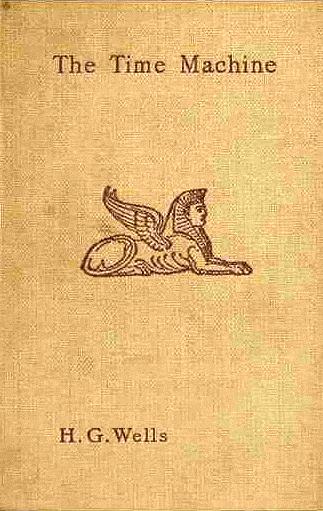
 Why was there a stature of a Sphinx? Why did Wells think that the symbolism of a Sphinx was so important that it would have survived all those centuries? From what I read later, Wells even requested that a Sphinx be on the front cover of the first edition. What riddle did the Time Traveler have to solve other than how to open the panels to retrieve his machine (which he never did)?
What It Made Me Feel:
I was disappointed by how the museum seemed to me to be a deus ex machina for the Time Traveler, and was quite relieved when most of the items gained from there were lost to him.
I was surprised at how sparse the action was. I felt like there was so much more Wells could have written on the Eloi/Morlock situation. I couldn't help but wonder what the book would've been like had Verne written it instead, with his magnificent powers of invention.
I also, quite frankly, felt that the Time Traveler should have been just a bit more upset and tried harder to find Weena. Is that the Victorian view of Civilized Explorer and Noble Savage showing itself?
Notable Passages, Ideas or Themes:
As the origin of the phrase "time machine" and credited as the earliest time travel novel, the Time Machine is a must read for fantasy and sci-fi fans. It just took me a long time to get around to it. . . I did read an abridged version as a pre-teen, though, in my defense.
What It Made Me Think:
I thought a lot about how commonplace the idea of time travel seems to me, in 2017, and yet how sensational the idea must have been in 1895. Many of the ideas were original, or at least appearing in print for the first time, so it must have been astounding to most of the readers. When able to step back from all my "knowledge" of time travel, and see it as a new thing, I got a real thrill out of Wells' story.
I was quite surprised at how much of the novel was used as a social commentary on socialism, the role of women/men in society, society in general, and industrialization.
I thought a good deal, after finishing the novel, about the direction of the future of humanity.
I think Wells was trying to make a point by the trip further into the future, but I'm not sure I fully grasped what he wanted to say. I see it as a full circle, creature to man back to creature, but I'm not sure if that is all that was intended.
What It Made Me Feel:
I was disappointed by how the museum seemed to me to be a deus ex machina for the Time Traveler, and was quite relieved when most of the items gained from there were lost to him.
I was surprised at how sparse the action was. I felt like there was so much more Wells could have written on the Eloi/Morlock situation. I couldn't help but wonder what the book would've been like had Verne written it instead, with his magnificent powers of invention.
I also, quite frankly, felt that the Time Traveler should have been just a bit more upset and tried harder to find Weena. Is that the Victorian view of Civilized Explorer and Noble Savage showing itself?
Notable Passages, Ideas or Themes:
Socialism, as I've mentioned, was a theme that Wells was attempting to portray in a positive light by showing the evil deterioration of industrialization.
Other themes were the innocence of Weena, lost to the violence of the offspring of industrialization, and the fire of civilization that ran out of control and burned the forest. (I'm not fully certain what Wells meant by that, but it's too obvious to have been unintentional.)
Saturday, December 31, 2016
December Wrap Up
I read 12 books and 5 audio books this month, bringing my totals to 95 books read and 69 audio books completed in 2016.
The most disappointing book of the year was Of Fire and Stars (review). My favorite book for December was Words in Blue (review), though Heartless (review) was close behind. My favorite book of the year was the Explorers Guild, with Kids of Appetite (review) as a close second. I read the Explorers Guild before I started reviewing again, but do plan to reread it in the next few months and will review it then.

The most disappointing book of the year was Of Fire and Stars (review). My favorite book for December was Words in Blue (review), though Heartless (review) was close behind. My favorite book of the year was the Explorers Guild, with Kids of Appetite (review) as a close second. I read the Explorers Guild before I started reviewing again, but do plan to reread it in the next few months and will review it then.

Friday, December 23, 2016
Frogkisser! by Garth Nix
Frogkisser!
Garth Nix
expected publication date: February 2017
5/5 stars
 Princess Anya's stepstepfather is becoming an evil sorcerer, intent on taking over their small kingdom, transmogrifying people into animals right and left. To return visiting Prince Denholm from his frog-form, Anya must make a Transmogrification Reversal Lip Balm. Aided by one of the palace's talking dogs, and joined by a boy-turned-newt and an otter-turned-human, Anya goes on a Quest for the ingredients, while trying to avoid being captured by her stepstepfather. Along the way, she learns about the All Encompassing Bill of Rights and Wrongs, the dangers of wielding power, and the importance of treating people fairly.
Anya is a wonderful heroine. She is eager for knowledge, and is a believer that a princess should "rescue herself". She was believable, especially as she was not fearless, but tried to be brave while frightened. The other characters, while not all as fully fleshed out as Anya, were also a pleasure to know.
The plot was a delightful mix of fairy tale and fantasy, exciting and fun. Nix writes well, and I was immersed in his world from the beginning.
Overall, Frogkisser! is a charming tale with lovable characters and an engaging plot. It is perfect for the recommended age group, but may also appeal to Young Adult readers.
Garth Nix
expected publication date: February 2017
5/5 stars
Princess Anya's stepstepfather is becoming an evil sorcerer, intent on taking over their small kingdom, transmogrifying people into animals right and left. To return visiting Prince Denholm from his frog-form, Anya must make a Transmogrification Reversal Lip Balm. Aided by one of the palace's talking dogs, and joined by a boy-turned-newt and an otter-turned-human, Anya goes on a Quest for the ingredients, while trying to avoid being captured by her stepstepfather. Along the way, she learns about the All Encompassing Bill of Rights and Wrongs, the dangers of wielding power, and the importance of treating people fairly.Anya is a wonderful heroine. She is eager for knowledge, and is a believer that a princess should "rescue herself". She was believable, especially as she was not fearless, but tried to be brave while frightened. The other characters, while not all as fully fleshed out as Anya, were also a pleasure to know.
The plot was a delightful mix of fairy tale and fantasy, exciting and fun. Nix writes well, and I was immersed in his world from the beginning.
Overall, Frogkisser! is a charming tale with lovable characters and an engaging plot. It is perfect for the recommended age group, but may also appeal to Young Adult readers.
Saturday, December 17, 2016
Caraval by Stephanie Garber
 Caraval
Stephanie Garber
expected publication date: January 2017
4/5 stars
Caraval (the first in a projected two-part series) is a tale of two sisters who deeply love and look out for each other while thye live under the tyranny of an abusive father. Since they were young, Scarlett and Donatella have both dreamed of joining in Caraval, a performance game full of illusion and mystery, where nothing is as it seems. This year, they receive invitations, run away from their father, and enter the world of Caraval--opening themselves up for magic, love, and heartbreak.
 I was captivated by Garber's storytelling from the very first sentence, and stayed entranced through out the entire novel. Her descriptions and metaphors were stunning, and the imagery from Scarlett's ability to feel in color was remarkably beautiful.
 This novel doesn't have extensive world building, but this is not missed, as most of the novel takes place during the game and environs of Caraval. The characters and their actions were well-written and generally believable. The plot was riveting, taking many turns and twists; often when I thought I knew what exactly was happening or would come next, I was completely surprised.
I was in awe reading this book, until the last few chapters. I don't want to spoil any of the plot for anyone, but I must say that I found the deus ex machina solution to be down-letting,
Excluding that disappointment, Caraval is well worth reading, with the first 90% being phenomenal.
(On a personal note: It breaks my heart not to be able to give this book a five star review. It was so amazing until the very end. I nearly capitulated and gave it five stars anyway, but. . . I had to be honest.)
Tuesday, December 13, 2016
Flicker and Mist by Mary G. Thompson
Flicker and Mist
Mary G. Thompson
projected publication date: 1/2017
3/5 stars
On the island of the Upland, people are divided into two races: Lefties and Plats. Myra is the child of the only mixed race couple in the capital city of New Heart City, and both she and her parents face discrimination as a result. In the past, Flicker Men invaded the Upland and bred with the Lefties, creating a sub race of Lefties known as the "Flickerkin". Flicker Men, and the Flickerkin, can "flicker" or become invisible at will. This ability is feared, and all Lefties are tested before they can enter New Heart City. Myra's mother passed the test, somehow, but is actually a Flickerkin. Myra herself has flickered once, and must be sure that it never happens again. When it becomes obvious that Flickerkin have infiltrated New Heart City, Myra and her parents face great danger.
If it sounds confusing, that's because, at times, it is. (I didn't even mention the sports, politics, religion, and dystopian elements, nor the quotes from the religious works and political documents.) Thompson wants very much to create an original world, and she does, but she adds so much to it that the reader is overwhelmed, both by the world details and the complicated plot.
Flicker and Mist does have positive themes, which are certain to appeal to the young adult reader; themes of prejudices being broken, love overcoming hate, and people working together for peace.
Myra, as a character, is interesting and likable. It's easy for the reader to want her to succeed with her sports, her boyfriend, and her life in general. She is a strong female character, as is popular at this time, but she does feats that are, I think, above the ability of her age. This is fantasy, of course, but the reader needs to be able to believe the fantasy, and I had a difficult time believing in Myra or her world.
Flicker and Mist is marketed toward an audience of ages 12 and up, and I think that this is too dense a book and world for that age group. I think it is well suited for the older teen readers, though. (Note: this is my personal opinion, based on reading this book as an adult.)
Overall, while Flicker and Mist has an interesting premise, I found the plot to be over-complicated and slow paced, and the writing was not compelling enough to completely draw me into the story. Other readers, however, and especially the traditional YA reader, may find this to be a thought-provoking look at race and equality.
Mary G. Thompson
projected publication date: 1/2017
3/5 stars
On the island of the Upland, people are divided into two races: Lefties and Plats. Myra is the child of the only mixed race couple in the capital city of New Heart City, and both she and her parents face discrimination as a result. In the past, Flicker Men invaded the Upland and bred with the Lefties, creating a sub race of Lefties known as the "Flickerkin". Flicker Men, and the Flickerkin, can "flicker" or become invisible at will. This ability is feared, and all Lefties are tested before they can enter New Heart City. Myra's mother passed the test, somehow, but is actually a Flickerkin. Myra herself has flickered once, and must be sure that it never happens again. When it becomes obvious that Flickerkin have infiltrated New Heart City, Myra and her parents face great danger.
If it sounds confusing, that's because, at times, it is. (I didn't even mention the sports, politics, religion, and dystopian elements, nor the quotes from the religious works and political documents.) Thompson wants very much to create an original world, and she does, but she adds so much to it that the reader is overwhelmed, both by the world details and the complicated plot.
Flicker and Mist does have positive themes, which are certain to appeal to the young adult reader; themes of prejudices being broken, love overcoming hate, and people working together for peace.
Myra, as a character, is interesting and likable. It's easy for the reader to want her to succeed with her sports, her boyfriend, and her life in general. She is a strong female character, as is popular at this time, but she does feats that are, I think, above the ability of her age. This is fantasy, of course, but the reader needs to be able to believe the fantasy, and I had a difficult time believing in Myra or her world.
Flicker and Mist is marketed toward an audience of ages 12 and up, and I think that this is too dense a book and world for that age group. I think it is well suited for the older teen readers, though. (Note: this is my personal opinion, based on reading this book as an adult.)
Overall, while Flicker and Mist has an interesting premise, I found the plot to be over-complicated and slow paced, and the writing was not compelling enough to completely draw me into the story. Other readers, however, and especially the traditional YA reader, may find this to be a thought-provoking look at race and equality.
Friday, December 9, 2016
Words in Deep Blue by Cath Crowley
 Words in Deep Blue
Cath Crowley
projected publication date: June 2017
5/5 stars
 Rachel is in a deep depression after the death of her brother, and for a change of scene, moves back to her home town to live with her aunt. While there, she reconnects with her former best friend, Henry, on whom she had a massive crush before she moved away. Working with him in his family's second hand bookshop, she finds herself drawn to him again.
 The bookshop has an unusual feature: the Letter Library. These are permanent books for the purpose of highlighting favorite passages or even leaving letters in for other people. One of the best parts of this Words in Deep Blue is reading the notes left in various books, plus the discussion of books by the characters. Crowley herself leaves a note for the reader; a wonderful surprise and an fantastic addition.
Crowley is an fine writer, and I was immediately captured by the plot and the realistic (and flawed) characters. This is a quick read, but one that I feel will stay with the reader for some time. In addition, Crowley gives some excellent book recommendations through her characters.
Words in Deep Blue is a teen love story, yes, but it's also a story about dealing with grief, taking chances, as well as a celebration of the written word. I highly recommend it, especially for young adults that love books and the words therein.
Note: for adults that might not want a teen love story, a similar book is The Storied Life of A J Fikry by Gabrielle Zevin, another 5 star read.
Thursday, December 8, 2016
The Sweet Dove Died by Barbara Pym
The Sweet Dove Died
Barbara Pym
4/5 stars
Leonora, beautiful, elegant, narcissistic, forms a relationship with Humphrey and his nephew James. While she appreciates Humphrey's attentions, she finds the company of the much younger James to be more desirable, until his lover comes between them.
While reading the Sweet Dove Died, I was reminded of quote by Somerset Maugham regarding Jane Austen:
Barbara Pym
4/5 stars
Leonora, beautiful, elegant, narcissistic, forms a relationship with Humphrey and his nephew James. While she appreciates Humphrey's attentions, she finds the company of the much younger James to be more desirable, until his lover comes between them.
While reading the Sweet Dove Died, I was reminded of quote by Somerset Maugham regarding Jane Austen:
"Nothing very much happens in her books, and yet, when you come to the bottom of a page, you eagerly turn it to learn what will happen next. Nothing very much does and again you eagerly turn the page. The novelist who has the power to achieve this has the most precious gift a novelist can possess."In this lightly comic book, the plot is minimal--nothing very much happens-- and yet the interest engendered by the characters compel the reader to continue to read. The actions and reactions of these characters, particularly Leonora, were so believable that I couldn't be sure where the story would go. The Sweet Dove Died is a satisfying exploration of various types of love, and yet Pym keeps her readers held at arms-length (like Leonora does her suitors) so there is little, if any emotional, involvement for the reader. Excepting that sterile feeling, this is an excellent book, well worth reading. (I would recommend, however, for new readers of Pym to start with Excellent Women.)
Subscribe to:
Posts (Atom)