A Monster Calls
Patrick Ness
3/5 stars
A Monster Calls is the emotional story of Connor, as he comes to grips with his mother's impending death. A Monster in the form of a giant yew tree begins to visit him (in reality or in his imagination is left to the reader to decide), telling Connor that he has come because Connor called him and is there to help.
Ness writes wonderfully, and is an excellent storyteller. Even when I wasn't enjoying the story, I was captivated by both the tale and the prose. The character of the Monster was fantastic, wild and gentle at the same time. I also liked how Ness slowly revealed parts of Connor's life, giving hints for the reader along the way.
I had mixed feelings about this novel. On the one hand, it is an excellent depiction of grief, and of the unraveling of reality and emotions during a time of extreme stress. Furthermore, it encourages the reader that it is okay to be angry about situations like this, and shows that fairy tale happy endings don't come about when dealing with terminal illness.
On the other hand, I didn't feel that Connor or the Monster gave the best example or advice for dealing with grief. The monster is encouraging Connor to act during two episodes when Connor has a mental breakdown and becomes violent. Encouraging as in urging him on to more destructive actions. In addition, this extreme damage to both a person and some property is glossed over, never fully addressed. "What good would it do?" is the reaction of the adults in his life. I felt that this was an unhealthy message to present to the target reader.
Granted, this is just my opinion: Patrick Ness won the Carnegie Medal for A Monster Calls, so other responsible adults feel that the lessons being taught are appropriate.

Monday, January 9, 2017

Sunday, January 8, 2017

Saturday, January 7, 2017
Giant's Bread by Mary Westmacott
Giant's Bread
Mary Westmacott
5/5 stars
 Giant's Bread was the first novel (1930) Agatha Christie wrote under her nom de plume "Mary Westmacott". It tells the life story of Vernon Deyer as he follows his destiny to become a composer, and the choices he makes along the way.
As is often with Christie's mysteries, Giant's Bread is a story of psychology, of what makes a person "tick", and it is a powerful story. The phrase "giant's bread" is taken from the fairy tale quote: "fee, fie, fo, fum, I smell the blood of mortal Man. Be he alive or be he dead, I'll grind his bones to make my bread." Deyer's composition was entitled "The Giant", and his life was made up of incidences of "grinding the bones" of those whom he loved and who loved him as he made his way toward a life of music.
Her description of a Victorian childhood was reminiscent of her autobiography (my review), and was wonderfully told. The WWI nurse's story was also an excellent example of the reality of that job.
Mary Westmacott
5/5 stars
Giant's Bread was the first novel (1930) Agatha Christie wrote under her nom de plume "Mary Westmacott". It tells the life story of Vernon Deyer as he follows his destiny to become a composer, and the choices he makes along the way. As is often with Christie's mysteries, Giant's Bread is a story of psychology, of what makes a person "tick", and it is a powerful story. The phrase "giant's bread" is taken from the fairy tale quote: "fee, fie, fo, fum, I smell the blood of mortal Man. Be he alive or be he dead, I'll grind his bones to make my bread." Deyer's composition was entitled "The Giant", and his life was made up of incidences of "grinding the bones" of those whom he loved and who loved him as he made his way toward a life of music.
Her description of a Victorian childhood was reminiscent of her autobiography (my review), and was wonderfully told. The WWI nurse's story was also an excellent example of the reality of that job.
I found this to be a compelling read, if not a quick one. The reader knows from the beginning that Deyer will write his masterpiece, but following his path to that point was emotional and intriguing.
Friday, January 6, 2017
December OwlCrate
The theme for the December OwlCrate was "epic", paying homage to epic fantasies. Here is what it contained:

- Of Fire and Stars by Audrey Coulthurt (my review here)
- A mystery mini vinyl Harry Potter figurine. I got Voldemort, as you can see; he looks great!
- An OwlCrate exclusive greeting card of Lucy, the lamppost, and Mr. Tumnus of The Lion the Witch and the Wardrobe, illustrated by @susanne_draws. I'm using this stunner in with my snowy decor for January. This is definitely the best part of the box!
- An amazingly creepy Eye of Sauron pin by @jane_mount, another exclusive OwlCrate item, which I can't wait to use.
- A sticker with a quote from A Darker Shade of Magic, designed exclusively for Owlcrate by @missphi. I've not read this series yet, but am planning to do so.
- A set of four Game of Thrones coasters. I was meh about these, as I never could get into Game of Thrones.
This was certainly not my favorite box (last month's was), but it was, as always, fun to receive!

Thursday, January 5, 2017
The Classics Club: The Time Machine by H.G. Wells
(about the Classics Club)
 Why I Chose This Classic:
As the origin of the phrase "time machine" and credited as the earliest time travel novel, the Time Machine is a must read for fantasy and sci-fi fans. It just took me a long time to get around to it. . . I did read an abridged version as a pre-teen, though, in my defense.
What It Made Me Think:
I thought a lot about how commonplace the idea of time travel seems to me, in 2017, and yet how sensational the idea must have been in 1895. Many of the ideas were original, or at least appearing in print for the first time, so it must have been astounding to most of the readers. When able to step back from all my "knowledge" of time travel, and see it as a new thing, I got a real thrill out of Wells' story.
I was quite surprised at how much of the novel was used as a social commentary on socialism, the role of women/men in society, society in general, and industrialization.
I thought a good deal, after finishing the novel, about the direction of the future of humanity.
I think Wells was trying to make a point by the trip further into the future, but I'm not sure I fully grasped what he wanted to say. I see it as a full circle, creature to man back to creature, but I'm not sure if that is all that was intended.
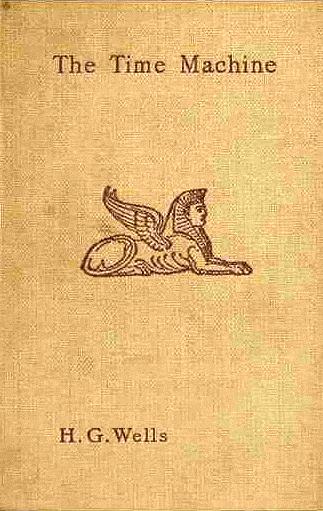
 Why was there a stature of a Sphinx? Why did Wells think that the symbolism of a Sphinx was so important that it would have survived all those centuries? From what I read later, Wells even requested that a Sphinx be on the front cover of the first edition. What riddle did the Time Traveler have to solve other than how to open the panels to retrieve his machine (which he never did)?
What It Made Me Feel:
I was disappointed by how the museum seemed to me to be a deus ex machina for the Time Traveler, and was quite relieved when most of the items gained from there were lost to him.
I was surprised at how sparse the action was. I felt like there was so much more Wells could have written on the Eloi/Morlock situation. I couldn't help but wonder what the book would've been like had Verne written it instead, with his magnificent powers of invention.
I also, quite frankly, felt that the Time Traveler should have been just a bit more upset and tried harder to find Weena. Is that the Victorian view of Civilized Explorer and Noble Savage showing itself?
Notable Passages, Ideas or Themes:
As the origin of the phrase "time machine" and credited as the earliest time travel novel, the Time Machine is a must read for fantasy and sci-fi fans. It just took me a long time to get around to it. . . I did read an abridged version as a pre-teen, though, in my defense.
What It Made Me Think:
I thought a lot about how commonplace the idea of time travel seems to me, in 2017, and yet how sensational the idea must have been in 1895. Many of the ideas were original, or at least appearing in print for the first time, so it must have been astounding to most of the readers. When able to step back from all my "knowledge" of time travel, and see it as a new thing, I got a real thrill out of Wells' story.
I was quite surprised at how much of the novel was used as a social commentary on socialism, the role of women/men in society, society in general, and industrialization.
I thought a good deal, after finishing the novel, about the direction of the future of humanity.
I think Wells was trying to make a point by the trip further into the future, but I'm not sure I fully grasped what he wanted to say. I see it as a full circle, creature to man back to creature, but I'm not sure if that is all that was intended.
What It Made Me Feel:
I was disappointed by how the museum seemed to me to be a deus ex machina for the Time Traveler, and was quite relieved when most of the items gained from there were lost to him.
I was surprised at how sparse the action was. I felt like there was so much more Wells could have written on the Eloi/Morlock situation. I couldn't help but wonder what the book would've been like had Verne written it instead, with his magnificent powers of invention.
I also, quite frankly, felt that the Time Traveler should have been just a bit more upset and tried harder to find Weena. Is that the Victorian view of Civilized Explorer and Noble Savage showing itself?
Notable Passages, Ideas or Themes:
Socialism, as I've mentioned, was a theme that Wells was attempting to portray in a positive light by showing the evil deterioration of industrialization.
Other themes were the innocence of Weena, lost to the violence of the offspring of industrialization, and the fire of civilization that ran out of control and burned the forest. (I'm not fully certain what Wells meant by that, but it's too obvious to have been unintentional.)
Tuesday, January 3, 2017

2017 Goal
I don't usually set goals for reading, or really have a TBR pile. This year, though, I'm going to try to get back into reading nonfiction. These are some of the ones I plan to read, or at least start, this year.


Subscribe to:
Posts (Atom)